
2026 Update: The Home Services Guide to Marketing ROI in 2026

At Coalmarch Marketing, we've spent over two decades helping home services companies transform their marketing from guesswork into growth engines. This guide shows you exactly how to track, measure, and maximize your marketing ROI with data-driven decisions that fuel sustainable growth.
Key Takeaways
- Track every touchpoint: Use call tracking, analytics, and local platform insights (e.g., Google Business Profile, Local Services Ads, AI appearances) to attribute revenue and capture leads that never generate a traditional website session.
- Focus on high-ROI channels: Email marketing generates $36-$42 for every $1 spent, while PPC advertising averages a 200% return, making them essential components of a data-driven digital marketing strategy.
- Measure what matters: Key metrics like cost per lead, conversion rate, customer lifetime value, and cost per acquisition determine the true profitability of your marketing efforts.
Why ROI Should Drive Your Digital Marketing Decisions
Most home services companies pour money into marketing without understanding which channels actually work. 83% of marketing leaders now consider demonstrating ROI their top priority, up from 68% five years ago.
Traditional advertising—billboards, radio, print—makes accurate measurement nearly impossible. A homeowner sees your billboard, remembers your brand weeks later, searches Google, reads reviews, and then calls. How do you attribute that sale? You can't. But even digital touchpoints now require broader visibility tracking. A homeowner may see you in conversational AI results, maps, ads, or social listings before converting — often without a recorded website session.
Digital marketing makes all this data readily accessible. You can track which campaigns generate the most leads and invest in those that deliver the highest return. When you can't measure performance, you can't optimize spend.
Industry Benchmarks for Home Services
Coalmarch Marketing works exclusively with pest control companies and lawn care businesses, which means we understand the seasonal patterns and customer behaviors specific to your industry.
Marketing channels that deliver consistent ROI for home services:
- Pay-per-click advertising: Generates an average 200% return when properly optimized
- Email marketing: Delivers $36-$42 for every dollar invested
- Search engine optimization: Can deliver 317-1,389% ROI as organic visibility compounds over time
- Content marketing: Companies that blog consistently see 13 times more positive ROI than those that don't
Essential PPC Metrics Every Home Services Business Must Track
Pay-per-click advertising lets you meet customers at their exact point of need. Understanding key metrics helps you evaluate campaign performance and make informed budget decisions.
Cost Per Click (CPC)
Your average CPC is what you spend per click on your website. CPCs vary significantly by industry and market, so there's no universal benchmark.
Use this metric to forecast the budget. If your average CPC is $10 and your conversion rate is 10%, you'll need approximately $1,000 to generate 10 leads.
In the current advertising landscape, your average CPC still matters — but it’s no longer the only efficiency signal. With fewer website clicks overall due to AI and zero-click search, focus also on cost per qualified lead and lead intent, not just CPC alone.
Impressions and Click-Through Rate
Impressions show how many people saw your ad, indicating search volume. Click-through rate (CTR) measures the percentage who clicked. Visibility without clicks can still mean conversions through local profiles or direct calls. CTR should be interpreted alongside off-site engagement data.
Conversion Rate and Cost Per Conversion
Your conversion rate is the percentage of clicks that result in your desired action—such as a phone call, form submission, or sale. Cost per conversion represents your actual cost to acquire a lead or customer. This metric directly connects marketing investment to business results. Many conversions now happen without a recorded website event (calls, messages, GBP actions, LSA bookings). Make sure your tracking includes those signals.
Questions to consider when analyzing conversion rates:
- Are you targeting relevant keywords?
- Does your website provide a good user experience?
- Is your messaging benefits-focused?
- Do you clearly communicate your value proposition?
How SEO Compounds Over Time to Lower Your Cost Per Lead
While PPC delivers immediate results, SEO operates differently—and often more profitably in the long term. SEO is one of the few marketing channels where ROI compounds over time, with each month building on the previous month's results to drive exponential growth. The nature of organic performance has shifted in 2026. Organic website sessions may decline due to search engines answering more queries directly in results pages, yet organic visibility still drives more qualified leads through branded, service-oriented, and local intent searches.
Understanding the Compounding Effect
Think of SEO as a snowball rolling downhill. It starts small, but given time and consistent effort, it can turn into an avalanche of ROI.
- Content accumulates authority: A blog post published today continues ranking and driving traffic for months or years
- Backlink profiles strengthen: Each quality backlink improves your entire site's domain authority
- Rankings improve faster: As your site becomes more authoritative, new content climbs rankings more quickly
- Long-tail keywords multiply: Your content library captures an expanding universe of search queries
SEO vs. PPC: The ROI Timeline
Most home services businesses see SEO begin to outperform paid advertising within 9-12 months. While PPC delivers immediate clicks, SEO takes time to mature, but ultimately surpasses PPC ROI as organic visibility compounds.
Consider this 24-month comparison:
- Months 1-6: PPC dominates with immediate traffic. SEO is building—publishing content, earning backlinks, and making technical improvements. PPC cost per lead: $75. SEO: Not yet generating significant leads.
- Months 7-12: SEO gains momentum. Rankings improve, and you're capturing high-intent searches. The inflection point arrives. PPC cost per lead: $75 (unchanged). SEO cost per lead: $45 (now lower than PPC).
- Months 13-24: SEO becomes a revenue engine. Your established content ranks for hundreds of keywords, and new content performs better from day one. PPC cost per lead: $75 (unchanged). SEO cost per lead: $25 (continuing to decrease).
According to data from multiple sources, the best SEO results typically occur in years 2-3 of continuous optimization.
Why SEO Cost Per Lead Decreases While PPC Stays Flat
With PPC, you pay for every single click, forever. Stop paying, and traffic stops immediately. SEO builds valuable visibility beyond the traditional site traffic model. Content optimized for both user intent and AI/answer engines can drive impressions and conversions even if direct clicks are lower than in prior years. A well-optimized service page can rank for years, driving leads month after month with only minor updates.
This creates a powerful dynamic: as organic traffic increases, cost per lead decreases because you're not paying for each click. Your monthly SEO investment stays relatively stable while lead generation continues to grow.
Combining SEO and PPC for Maximum ROI
At Coalmarch, we don't ask clients to choose between SEO and PPC—we use both strategically. PPC provides immediate lead flow while you build your SEO foundation, then SEO progressively reduces your dependence on paid advertising.
An effective combined approach:
- Use PPC for high-intent keywords and immediate needs (emergency services, seasonal promotions, new service areas)
- Build SEO content around educational queries and long-tail keywords
- Analyze PPC keyword data to inform SEO strategy—if you're paying $50 per click, prioritize ranking organically
- As SEO rankings improve for competitive keywords, reduce PPC spend on those terms and reinvest in new opportunities
- Use PPC to test new service offerings while building SEO for long-term presence
Companies that combine SEO and PPC strategies often see 25% higher ROI than those relying on either channel alone.
Maximizing Your SEO Investment
To ensure your SEO investment compounds effectively:
- Invest in quality content: Create in-depth, audience-focused pieces that answer real questions. A single well-researched guide can outperform dozens of thin pages.
- Build authoritative backlinks: Earn links from reputable websites to boost domain authority. Learn more about the fundamentals of link building.
- Target long-tail keywords: Focus on specific, lower-competition phrases with higher conversion rates and faster ranking timelines.
- Optimize for local search: For home services serving specific areas, local SEO delivers strong ROI by capturing high-intent searches with location modifiers. Discover how to optimize your Google Business Profile.
- Periodically refresh top content: Well-maintained evergreen content continues to appreciate in value.
- Track rankings and adjust: Monitor keyword positions and organic traffic trends to identify opportunities.
Essential Tracking Technology
Call tracking assigns unique phone numbers to different marketing channels so you can track which strategies drive the most calls. When a potential customer calls, the technology records crucial information—caller location, time of day, call duration, and even transcripts.
Why Call Tracking Matters
In competitive industries like pest control and lawn care, call tracking provides a clear competitive advantage. You can invest resources in marketing channels that drive the most business. Call tracking helps you:
- Understand customer behavior: Analyze call patterns, peak times, frequently asked questions, and seasonal trends
- Fine-tune campaigns: Identify which campaigns drive calls, which keywords resonate, and what outreach compels prospects to contact you
- Personalize interactions: Access historical data so your team can provide tailored service
- Optimize staffing: Determine peak call times to ensure adequate coverage
Despite its name, call tracking captures data from phone calls, online forms, live chats, texts, and more, giving you a complete picture of the customer journey.
Google Analytics 4: Your Foundation for Data-Driven Marketing
GA4 represents a significant evolution, focusing on tracking individual users across multiple devices and sessions. GA4 centers on event-based tracking, allowing you to monitor a wide range of user interactions with greater granularity.
Important GA4 features for home services:
- Cross-device tracking: Follow customer journeys as they move from mobile to desktop
- Enhanced measurement: Automatically track scrolls, outbound clicks, site search, video engagement, and file downloads
- Data modeling: Machine learning fills gaps in data for more accurate insights
- Integration capabilities: Connect seamlessly with Google Ads, BigQuery, and other tools
Set up custom events to monitor specific user interactions, such as new customer phone calls, contact form submissions, quote requests, and service page visits. Enable data modeling to fill data gaps and deliver more accurate insights—particularly valuable as privacy restrictions increase.
Key Performance Indicators That Actually Matter
A key performance indicator demonstrates how effectively you achieve business objectives. KPIs ensure every team member stays accountable. What gets measured gets done—measuring your data allows you to manage processes and see improvements.
Setting Meaningful KPIs
Start by identifying your primary business objectives. Instead of vague goals like "save money" or "get more customers," break them into measurable components:
- Lead generation: Track both traditional and off-site leads (calls, messages, GBP actions), cost per qualified lead, and lead-to-customer conversion rates across touchpoints.
- Revenue: Monitor average customer value, recurring revenue, customer lifetime value, and monthly recurring revenue growth. Also consider intent signals (e.g., branded searches, local actions) as high-ROI precursors to conversions.
- Efficiency: Measure marketing spend relative to qualified outcomes, not just clicks — because many valuable interactions never register as sessions.
- Customer success: Track retention rate, cancellation rate, net promoter score, repeat purchase rate
Research shows that proving ROI with analytics remains a top-three challenge for marketing leaders, underscoring the need to establish clear KPIs from the start.
CRM Systems That Drive Accountability
A customer relationship management (CRM) system helps you stay connected to customers, streamline processes, and improve profitability. Your CRM tracks exactly where you are with every business relationship, current and future.
Maximizing Your CRM Investment
Popular CRM options for home services include PestPac, SA5, Service Fusion, and ServiceTitan. Follow these steps to maximize value:
- Step 1: Understand Your Data. Before running reports, define what a lead means to your company and how it appears in the system.
- Step 2: Set Systems. Most CRM platforms make reporting easy and can automatically send reports on your schedule. This takes time up front but saves time and energy in the long term.
- Step 3: Enforce Systems. Place rules around CRM usage to hold your team accountable. For example, require technicians to follow up with new leads the same day. Automated reports can highlight overdue leads.
- Step 4: Implement Change. Reports from your CRM help you make data-driven decisions. Having reports to back up decisions helps address employee pushback when making company-wide adjustments.
Essential Marketing Reports
Data without action means nothing. Your reporting systems should inform decisions, reveal opportunities, and hold teams accountable.
- Lead source reports show which marketing channels generate the most leads and at what cost per lead. This helps you allocate budget to high-performing channels.
- Conversion funnel reports reveal where prospects drop off in your sales process, allowing you to improve conversion rates at each stage.
- Customer acquisition cost reports track total marketing and sales expenses divided by the number of new customers acquired, ensuring you're acquiring customers profitably.
- Lifetime value reports calculate the total revenue a customer generates over their relationship with your company. This metric is crucial for home services businesses because recurring revenue customers become increasingly profitable after you recover acquisition costs in year one.
Set up automated reports through Google Ads, your CRM, and analytics platforms to maintain consistent visibility. Consider leveraging Google Ads automation to streamline campaign management. According to recent data, 72% of overall marketing budgets now go toward digital marketing channels, making proper reporting and optimization more important than ever.
Calculating True Marketing ROI
To accurately calculate marketing ROI, track leads and customers from initial contact through sale. For home services, this means monitoring:
- Total marketing spend: Include platform fees, ad spend, agency retainers, and internal labor costs
- Lead volume and quality: Count only first-time calls and qualified form submissions
- Conversion rates: Track how many leads become paying customers
- Average customer value: Calculate both initial service value and lifetime value for recurring customers
Understanding Customer Lifetime Value
Consider this example: In year one, you acquire 1,000 customers at a cost of $100,000. Those customers generate $500,000 in revenue, resulting in $50,000-$100,000 in profit. That's a 4X return on investment in the first year alone. With a 10% annual cancellation rate, you'll retain 90% of customers each year without additional acquisition costs. Those same 1,000 customers could generate:
- Year 1: 1,000 customers, $500,000 revenue
- Year 2: 900 customers, $450,000 revenue (no acquisition cost)
- Year 3: 810 customers, $405,000 revenue (no acquisition cost)
Over three years, your initial $100,000 investment generated $1,355,000 in revenue. This is why customer retention matters—it's much cheaper to keep existing customers than to acquire new ones.
Common Marketing ROI Mistakes to Avoid
Even with tracking in place, many home services businesses make critical errors that skew ROI calculations.
Forgetting to Track All Marketing Costs
Many companies track ad spend but forget platform fees, agency retainers, content creation costs, and internal labor. Accurate ROI requires accounting for every dollar invested.
Ignoring Customer Lifetime Value
Judging marketing effectiveness based solely on first-year revenue dramatically undervalues campaigns that generate recurring customers.
Not Accounting for Lead Quality
Not all leads are created equal. A campaign generating 100 low-quality leads that don't convert is less valuable than one producing 25 high-intent prospects who become customers. Track lead-to-customer conversion rates by source.
Setting and Forgetting Campaigns
Digital marketing requires continuous optimization. Regular review and adjustment of campaigns ensures you maintain a strong ROI over time.
The Future of Marketing ROI for Pest Control and Lawn Care
Several trends are shaping how home services companies will measure and optimize marketing ROI:
Artificial intelligence and machine learning are transforming marketing measurement. By 2025, 30% of businesses are expected to use AI-driven analytics tools to better understand and improve ROI. These tools identify patterns humans miss and provide predictive insights. They're also changing where decisions are made. Homeowners increasingly see answers, options, and recommendations without visiting a website, which means ROI must be measured across broader digital touchpoints.
- Privacy-first tracking requires new approaches as third-party cookies are phased out. First-party data collection through email lists, customer databases, and direct relationships becomes increasingly valuable.
- Attribution modeling advances help businesses understand complex customer journeys that touch multiple channels before conversion.
- Predictive analytics use historical data to forecast future performance, helping businesses make proactive decisions about marketing spend, hiring, and capacity planning.
Your Next Steps
Ready to transform your home services marketing from guesswork into a data-driven growth engine? Start with these steps:
- Audit your current tracking: Identify gaps in your ability to connect marketing spend to revenue. Can you calculate the cost per acquisition by channel?
- Implement call tracking: Assign unique phone numbers to each marketing channel to accurately attribute phone leads.
- Set up GA4 properly: Ensure you're tracking key events like form submissions, phone clicks, and quote requests.
- Define your KPIs: Establish clear metrics that align with business goals. Share these with your team and review regularly.
- Compare to benchmarks: Understand how your performance stacks up against industry averages.
- Optimize high performers: Once you identify which channels deliver the best ROI, invest more resources in them.
- Fix or eliminate low performers: Determine whether underperforming channels need optimization or should be eliminated.
Marketing your home services business effectively requires more than creative campaigns and compelling messaging. It demands rigorous tracking, honest analysis, and continuous data-driven optimization.
The home services companies that thrive in the coming years will treat marketing as an investment requiring measurable returns, not an expense to minimize. They'll use data to inform every decision, from budget allocation to campaign optimization to hiring plans. Your competitors are already making this shift. The question is whether you'll join them or fall behind.
Need help building a marketing strategy that delivers measurable ROI? Our team at Coalmarch Marketing specializes in pest control marketing and lawn care marketing that drives real business results. Contact us to discover how we can help you maximize your marketing investment.

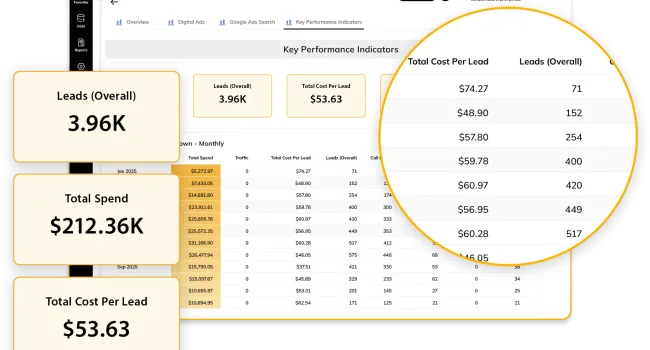

Marketing your home services business without tracking ROI is like driving with your eyes closed. Every dollar you invest in digital marketing should drive measurable results, but most pest control, lawn care, and HVAC companies struggle to connect their marketing spend to actual revenue.

AI search, agentic booking, and mobile-first behavior are reshaping how homeowners find and hire pest control and lawn care services. This year, it's primarily about building your brand, making it accessible to AI, and meeting customers where they are.