Customer Retention vs. Acquisition: What Actually Drives Growth?
How You Can Turn Customer Experience Into Higher ROI
The Growth Strategy Most Leaders Miss
Lawn & pest marketing pipelines often look healthy where leads come in and the phones are ringing. Yet even with a steady cost-per-lead and rising contact volume, revenue growth can lag. Customers quietly cancel annual plans or stop renewing, and business owners wake up wondering if they’re truly growing or just staying busy. In practice, most owners and GMs don’t have time to untangle every detail of every report. They just ask a simple question: is this growth real?
Often the answer is that the problem isn’t generating leads at all, but what happens after a lead converts and after the first service is delivered. In pest control and lawn care, retention is a foundation of growth: top operators report retention rates above 85%, creating a stable foundation for growth.
It’s not enough to acquire a customer – you must also keep them coming back.
The Hidden Cost of Chasing New Customers
Relying solely on new customer sign-ups can mask the true health of a business. When operational issues that cause churn go unaddressed, companies end up constantly replacing lost customers just to stay even. Instead of acquiring customers to fuel real growth, they’re acquiring customers to plug leaks.
Here are some common operational issues that need to be addressed to improve retention:
- Inconsistent Service Results: Weeds return quickly, pests reappear, or outcomes vary from technician to technician, leading customers to question the program’s effectiveness.
- Poor Communication & Follow-Up: Missed reminders, unclear expectations, slow response times, or lack of post-service check-ins create frustration and uncertainty.
- Scheduling & Reliability Issues: Missed appointments, frequent reschedules, or rushed visits erode trust and reduce perceived value.
- Billing & Contract Friction: Confusing pricing, unexpected charges, or automatic renewals without clear communication damage long-term loyalty.
- Experience & Professionalism Gaps: Inconsistent technician behavior, lack of property care, or failure to educate the customer weakens confidence in the service.
- Wasted Spend: New leads are purchased to replace customers who should have stayed. Growth dollars turn into retention band-aids.
- Unseen Churn: Customers cancel or fail to renew due to service, communication, or experience gaps, yet the root causes remain unexamined.
- Incomplete Metrics: Cost-per-lead may appear healthy, but without measuring cost-per-sale, retention rate, and customer lifetime value, the business may be spending aggressively just to break even.
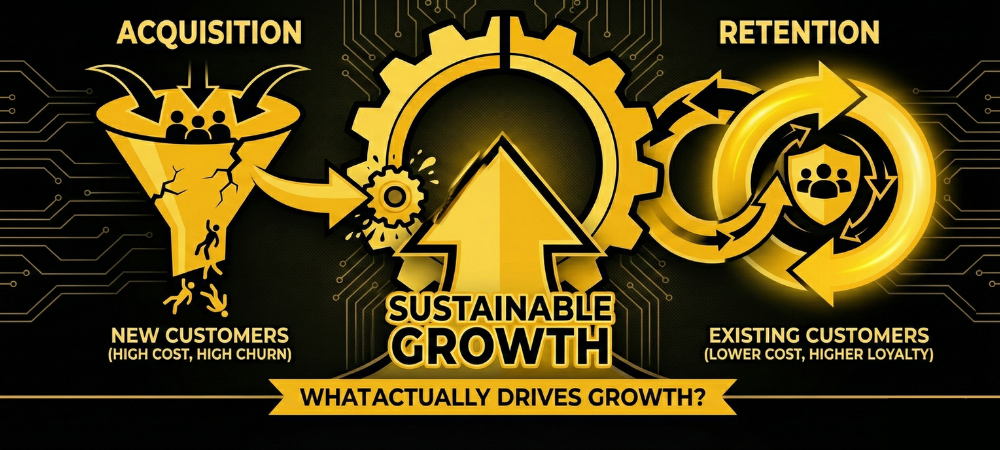
Acquisition can look like growth until you account for who you’re losing. New customer acquisition can run 5 to 10 times the cost of selling to existing ones. Chasing volume without fixing churn simply inflates figures and drives up effective cost-per-customer.
Why This Matters More Than It Seems
This misalignment has a real impact on leadership decisions. Budgets and resources are often set on incomplete data, focusing on CPL and lead volume while ignoring retention. In such cases, even good marketing channels can look weak if their customers don’t stick around. Sales and marketing teams lose alignment, each blaming the other: marketing for lead quality, sales for follow-up. Growth ends up feeling risky and unstable.
In reality, data-driven leaders know that you can’t improve what you don’t measure. A recent analysis emphasizes that retention metrics give insight into what’s working in your business. Without combining acquisition and retention, executives revert to gut feeling instead of clarity. Smart leaders tie acquisition to actual sales and retention together, ensuring decisions are based on clear ROI, not just impressions or clicks.
Key Insight #1: Acquisition Without Retention Distorts ROI
Every new customer comes with an acquisition cost, and that cost only makes sense if the customer stays long enough to pay it back. For example, if it costs $200 to acquire a customer and they spend $800 over their lifetime, the math works – a healthy return. But if that customer only sticks around long enough to pay $300 total, then your model is broken.
In that case, marketing spends no longer multiply profit; they erode it. The result is a distorted ROI: marketing appears inefficient, sales comes under pressure to “sell harder,” and leadership starts to wonder if growth is sustainable. You simply can’t evaluate ROI accurately without understanding how long customers stay. When retained revenue is factored in, a dollar spent on retention delivers far more ROI than a dollar on pure acquisition.
Check Out Our Home Services Guide to Marketing ROI
Key Insight #2: Retention Is an Operational Advantage, Not a Marketing Tactic
Retention isn’t something you fix with one more campaign. Rather, it’s built every day, in every customer interaction. It starts on the first call and never ends. How you handle incoming inquiries, set expectations in onboarding, schedule follow-ups, and communicate during service all drive retention. For instance, establishing an official retention process ensures that every member of the team plays a part in keeping customers happy.
Retained customers immediately lower the pressure on acquisition budgets for each renewal and add-on service compound revenue without extra ad spend. They also spread the word. Satisfied customers often recommend a company to their friends and family, making word-of-mouth a powerful growth tool. Retention becomes a profit driver because loyal customers buy more and cost less to maintain.
The real levers of retention lie in consistent execution: on-time services, reliable techs, and responsive communication. Not in chasing discounts or ads.
Key Insight #3: Lead Quality and Retention Are Connected
It turns out acquisition and retention go hand-in-hand. High-quality leads like those who fit your ideal customer profile, not only convert faster, but they also stay longer. When prospects are properly qualified, sales cycles shorten and churn plummets. The right customers renew, they expand, and they refer, whereas bad-fit customers leave as soon as their contract allows it.
In practical terms, this means focusing on lead quality improves both immediate and long-term results. Modern tools can help: CRM and AI systems now track outcomes and score leads, so teams focus only on prospects most likely to become loyal clients. Not all growth is equal, as the right new customers create leverage, boosting lifetime value, whereas raw volume without fit can actually undermine revenue goals.
Turning Routine Services Into Loyalty Builders
Lawn and pest services are inherently recurring but often low-engagement, which actually creates more opportunities for customer satisfaction. Each treatment visit can be a touchpoint to reinforce value. Small experience wins can yield large retention gains. For example, proactive communications like automated reminders of upcoming treatments keep schedules on track and reduce cancellations.
What to Look At Right Now
Improving visibility isn’t about adding more reports. It’s about removing blind spots. Ask yourself and your team these questions to identify the tracking gaps in your business's customer journey:
- Do your reported metrics match what you see in the office? (High leads but low bookings may signal a hidden funnel leak.)
- Can you follow a lead from first contact all the way to booked revenue? If not, where is the disconnect?
- Do you know precisely where and why customers cancel or fail to renew?
- Are acquisition and retention discussed together in your team meetings or separately?
Remember you can’t improve what you don’t measure, so take care to connect the dots between marketing, sales, and service data
The Bigger Picture: Sustainable Growth Comes From What You Keep
In the long run, acquisition fuels the business, and retention stabilizes it. Working together, they build predictable, scalable growth. By prioritizing retention, every marketing dollar goes farther, and teams align around shared goals. In fact, the perpetual race for new customers is both exhausting and expensive.
Shifting focus from cost to long-term value creates an investment mindset: each happy customer retained is worth more than one gained. The leaders who build this into their strategy find that scaling feels intentional instead of frantic.
Growth isn’t just about how many customers you add – it’s about how many you keep.
The Bottom Line for Pest & Lawn Leaders
Lawn and pest control leaders know the drill: growth is critical, but so is efficiency. By rebalancing the equation between acquisition and retention, you can turn customer experience into higher ROI. Staying busy with new leads might feel productive, but the smartest growth comes from nurturing and holding onto the customers you’ve earned. Companies that grasp this and build their processes around retention and acquisition together will be making smarter, sustainable decisions long before the next busy season arrives.


Mid-season pressure often leads operators to misinterpret normal fluctuation as marketing failure. This blog outlines five lead insights that help businesses evaluate performance more accurately, reduce reactive optimization, and connect leads to revenue with greater clarity.